Isaac Newton for Kids
Meet the curious farm boy who became history's most famous scientist. This guide tells Newton's story the way kids ages 7–10 will actually remember it — with a timeline, fun facts, at-home experiments, and answers to every big question.
Best for
Ages 7–10
Read time
~12 min
Sections
8
Activities
3 hands-on
The Book
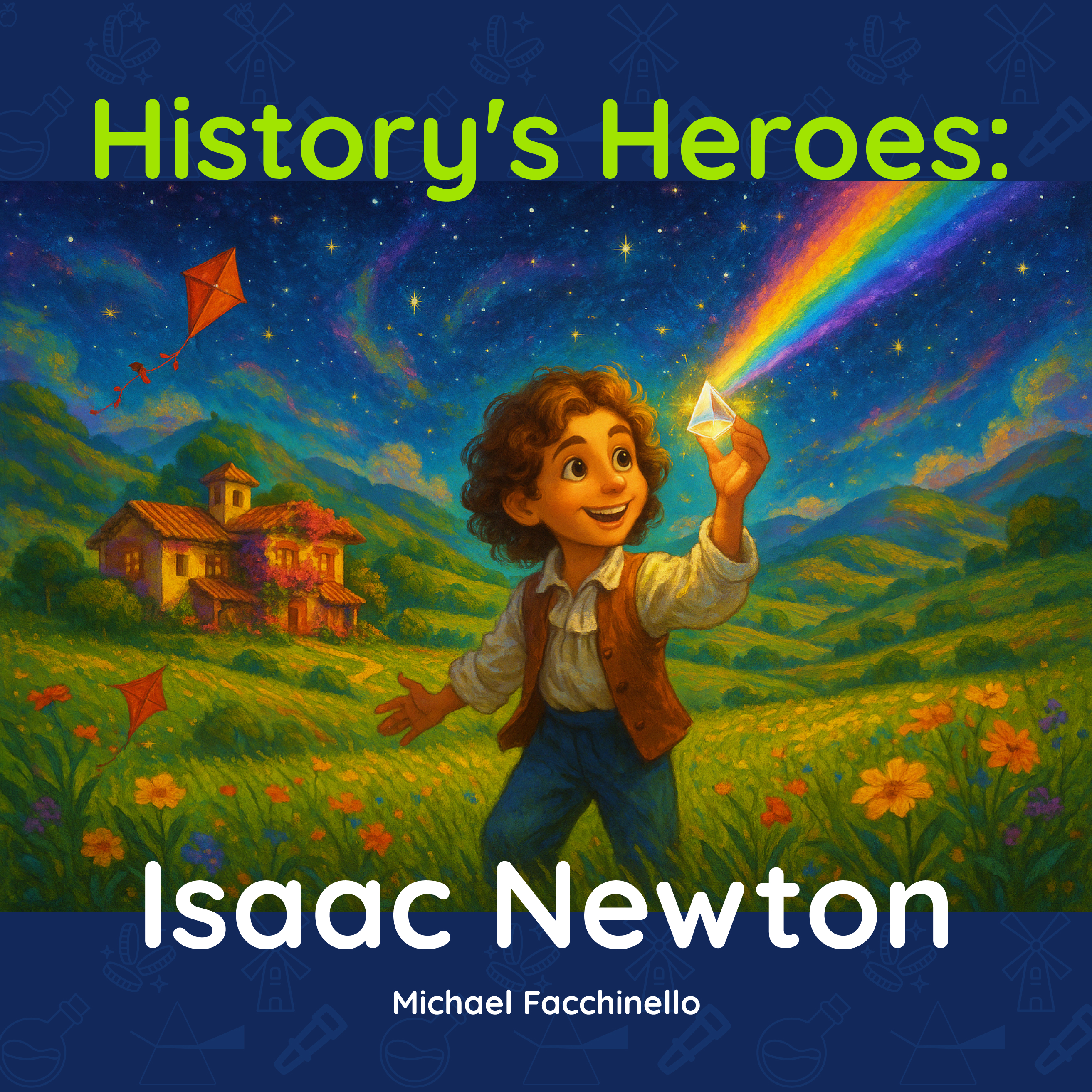
Pair this guide with our picture book — a story-led intro for ages 4–8.
View the bookBuy it on AmazonIsaac Newton: A Story-Led Picture Book
Before Isaac Newton became one of history's greatest scientists, he was a curious farm boy who couldn't stop asking why. Beautifully illustrated and built for ages 4–8, our book pairs perfectly with this guide for older siblings, read-alouds, and classroom units.
Biography
The story of Isaac Newton, in 5 short chapters
On Christmas Day in 1643, in a quiet English farmhouse called Woolsthorpe Manor, a baby boy was born who was so tiny his mother said he could fit inside a quart mug. Nobody thought he would live a week. But he did. His name was Isaac Newton, and he grew up poking, asking, and wondering about everything. His father had died before he was born, and when his mother remarried, she sent young Isaac to live with his grandmother. He was often lonely. So he filled his time with experiments. He built tiny water clocks, windmills you could fit in your pocket, and a paper kite with a candle inside that he flew at night to scare the neighbors.
When Isaac was twelve, he was sent to the grammar school in Grantham. At first he was one of the worst students in the class. Then one day a boy kicked him in the stomach. Isaac decided he wasn't going to lose to that boy at anything — not at fighting and not at school. He started studying harder than anyone, and by the time he left, he was the very top of his class. His uncle noticed how clever he was and helped him get into Trinity College at Cambridge University, even though Isaac had to work as a servant to other students to pay his way.
Then something terrible happened that ended up being lucky for science. A disease called the Great Plague swept through England, and Cambridge closed its doors. Isaac, who was just 23, went home to Woolsthorpe. For nearly two years he stayed in the orchard and the farmhouse with almost nothing to do — except think. In that one short stretch, sometimes called his "year of wonders," Isaac sketched out the idea of gravity, started inventing a brand-new kind of math called calculus, and worked out that sunlight is secretly made of every color of the rainbow. It was the most amazing burst of ideas any single person has ever had. And yes, the famous apple really did fall.
Back at Cambridge, Isaac kept inventing and discovering. He built the world's first reflecting telescope — only six inches long, but better than the giant lens telescopes everyone else used. He shined sunlight through a prism and proved, for the first time, that white light is made of red, orange, yellow, green, blue, indigo, and violet, all mixed together. He became a professor. And in 1687, after twenty years of careful work, he published a huge Latin book called the Principia. In it, he wrote down three laws of motion that explain how almost everything moves — apples, planets, rockets, even you running across a soccer field.
Newton's ideas made him famous. Later in life he moved to London and ran the Royal Mint, where England's coins were made, and even hunted counterfeiters in disguise. In 1705, Queen Anne knighted him, so people started calling him "Sir Isaac Newton." He died in 1727, at the age of 84, and was buried in Westminster Abbey — the same church where kings and queens are crowned. Today, more than 300 years later, every rocket launch, every roller coaster, and every bouncing ball still follows the rules that the curious boy from Woolsthorpe wrote down. Not bad for a kid who started out asking, "Why does the apple fall?"
Timeline
Isaac Newton's life, year by year
From a tiny baby on a farm to Sir Isaac Newton, scientist of the century — here are the big moments.
- •
1643
Born on Christmas Day in Woolsthorpe, England
Isaac was born so tiny and sickly that nobody thought he would survive his first week — but he did, and he grew up curious about everything.
- •
1655
Sent to grammar school in Grantham
Twelve-year-old Isaac built model windmills, sundials, and tiny mechanical toys instead of playing with the other kids.
- •
1661
Started at Trinity College, Cambridge
He worked as a servant to other students to pay for school and stayed up late reading every book on math and science he could find.
- •
1665–1666
The "Plague Years" back home at Woolsthorpe
When the plague closed Cambridge, Isaac went home and, in just two years, sketched out gravity, calculus, and his first ideas about light.
- •
1666
The famous falling apple
Sitting in his mother's orchard, Isaac watched an apple drop and asked the question that changed science: why does it always fall down?
- •
1668
Built the first working reflecting telescope
Isaac used curved mirrors instead of glass lenses, making a telescope just six inches long that worked better than ones ten times bigger.
- •
1672
Showed that white light is made of every color
He shined sunlight through a glass prism and proved that the rainbow inside it was already hiding in the light itself.
- •
1687
Published the Principia
His giant Latin book explained the three laws of motion and gravity — the same rules that send rockets to space today.
- •
1696
Became Master of the Royal Mint
Newton ran the place that made England's coins and even chased down counterfeiters who were making fake money.
- •
1705
Knighted by Queen Anne
He became "Sir Isaac Newton" — one of the first scientists ever knighted just for his science.
- •
1727
Died in London at age 84
He was buried in Westminster Abbey, the same church where kings and queens are crowned, because his ideas had changed the world.
Fun Facts
5 things you probably didn't know about Newton
Newton built the very first reflecting telescope using curved mirrors.
Why it matters: Almost every big telescope today — even the giant space ones — still uses Newton's mirror idea to see deeper into the universe.
The falling apple really happened, but the apple did not bonk him on the head.
Why it matters: Newton told the story himself. He watched an apple fall while sitting under a tree; the "hit on the head" version got added later to make it funnier.
Newton invented a new kind of math called calculus — at almost the same time as another scientist named Leibniz.
Why it matters: Calculus is how we measure things that are changing, like how fast a rocket speeds up. Two people invented it because the world was finally ready for it.
For 30 years, Newton was in charge of England's money as Master of the Royal Mint.
Why it matters: He hunted counterfeiters in disguise around London — a famous scientist working as a real-life detective.
Newton spent more time on alchemy (a kind of magic-chemistry) than he did on gravity.
Why it matters: He was trying to figure out the hidden rules of nature. Some experiments looked like wizardry, but the careful note-taking helped grow real chemistry.
Activities
3 hands-on Newton experiments to try at home
You don't need a lab to think like Newton. Try these with a grown-up using stuff you already have around the house.
The Apple Drop Test
Big idea: Heavy things and light things fall at the same speed.
- 1Hold an apple in one hand and a small toy in the other.
- 2Stand on a chair (with a grown-up watching) and let go of both at exactly the same time.
- 3Watch them land. Did they hit the floor together? Try heavier and lighter pairs.
Make a Rainbow With a Prism
Big idea: White light is secretly made of every color of the rainbow.
- 1Find a clear glass prism, a crystal pendant, or even a clear glass of water on a windowsill.
- 2Catch a sunbeam and let it pass through, then catch the light on a white piece of paper.
- 3Look closely: you'll see Newton's rainbow — red, orange, yellow, green, blue, indigo, violet.
The Re-Enacted Apple Moment
Big idea: Big science discoveries start with one curious question.
- 1Go outside or sit by a window. Watch something fall — a leaf, a ball, a feather.
- 2Ask "why?" the way young Isaac did: Why does it fall down? Why not up? Why does it speed up?
- 3Write down your best guess. Then test it. (Scientists call this a hypothesis.)
FAQ
Frequently Asked Questions
Quick answers for curious kids and the grown-ups helping them learn.
Who was Isaac Newton?+
Isaac Newton was an English scientist who lived from 1643 to 1727. He figured out how gravity works, explained how light and color work, and wrote down the three laws of motion that we still use today to send rockets into space.
What did Isaac Newton discover?+
Newton discovered the law of gravity, the three laws of motion, the way a prism splits white light into a rainbow, and a brand-new kind of math called calculus. He also invented the first reflecting telescope.
Is the apple story true?+
Yes — mostly. Newton really did watch an apple fall in his mother's orchard in 1666, and that did help him think about gravity. The famous "apple hit him on the head" version was added by storytellers later to make it more exciting.
What is gravity, in kid-friendly words?+
Gravity is an invisible pull that every object with mass has on every other object. Earth is huge, so its pull keeps you, your dog, the ocean, and even the moon stuck close to it. The bigger something is, the stronger its gravity.
Did Newton really invent calculus?+
He invented it at about the same time as another scientist named Gottfried Leibniz, in Germany. They each came up with it on their own. Today we use a mix of both of their ideas — and it powers everything from video games to space missions.
How old was Newton when he died?+
Isaac Newton was 84 years old when he died on March 31, 1727, in London. He was buried in Westminster Abbey, a famous church where kings and queens are crowned, because his ideas had changed the world.
Why is Isaac Newton famous?+
Newton is famous because he found three big rules — the laws of motion — that explain how almost everything moves. Apples, cars, planets, and rockets all follow Newton's laws. His ideas became the foundation of modern science.
What is the best book about Isaac Newton for kids?+
For ages 4-8, History's Heroes: Isaac Newton is a story-led picture book that introduces Newton as a curious farm boy who couldn't stop asking why. It's a warm read-aloud with accurate history, beautiful illustrations, and a free 4-week curriculum to go with it.
Read the Story
Bring Newton's story home
History's Heroes: Isaac Newton is the story-led picture book that started it all. Warm, accurate, beautifully illustrated — the perfect read-aloud for curious kids ages 4–8 (and older siblings sneak-reading along).